
Art-Science Collaboration Framework: Play as a concept
 Lists
Lists Lists
Lists


Berry-Frith, Joanne (2023) Art-Science Collaboration Framework: Play as a concept. In: Proceedings of Relating Systems Thinking and Design Volume: RSD12, 06-20 Oct 2023.
Preview |
Text
RSD12_Paper_18_2023.pdf Available under License Creative Commons Attribution Non-commercial No Derivatives. Download (989kB) | Preview |
![[thumbnail of RSD12_Image_314-1560x2048.png]](https://openresearch.ocadu.ca/id/eprint/4875/2/RSD12_Image_314-1560x2048.png "RSD12_Image_314-1560x2048.png")  Preview |
Image
RSD12_Image_314-1560x2048.png Available under License Creative Commons Attribution Non-commercial No Derivatives. Download (4MB) | Preview |
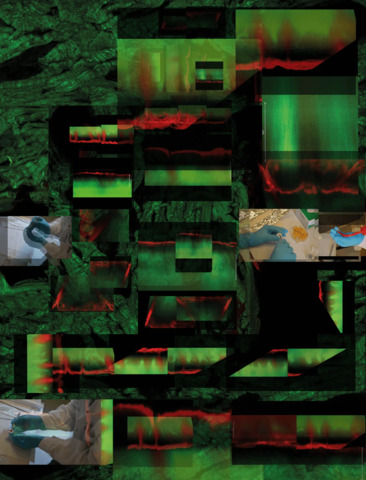
Abstract
How can an artist-researcher develop a framework by testing play as a concept to advance relationships through art-science collaboration that leads to behavioural change?
Bioimaging experiments are carried out in discrete labs, and artists are rarely granted access. This seemed to be an underused resource for artists, and I asked myself how I could contribute to art-science initiatives in advanced imaging and microscopy labs as an artist-researcher. I responded innovatively to current circumstances in bioimaging by thinking about scientific and artistic interdisciplinary practice in a “playful” way. Established play theories and practises from the material I examined, analysed and then modified influenced my work.
As an artist, my research is situated within a group of artists who investigate complex fields of scientific subject matter and engage in an ongoing process of dialogue that has generated new knowledge in science and art. To supplement the work of these artists, I conducted a case-study review based on three scientific research institutes in the United Kingdom and Sweden. My contribution to knowledge beneficial for the fields of both art and science was to introduce play as a disruptive concept. I developed a four-stage, adaptable framework for working with scientists, which I created while collaborating with experts in the field. Alongside this, my research revealed a desire to collaborate from both cultures and that interaction through the application of this framework allowed for a more flexible approach. We accepted that it was okay if artists and scientists did not achieve the same aims or conclusions. It is also clear from this research that working on socially relevant academic topics has substantially influenced the evolution of my research outputs when it is based on adopting a performative, process-based approach (Kestner, 2013: 1). The research demonstrated how scientific knowledge was necessary to my practice, serving as a bridge between art and science. The concept of play allowed me to disrupt artistic and scientific methods of analysis, moving focus away from a purist approach. Deploying play as a strategy was key to dismantling silo mentalities and demonstrating how artist-researchers can contribute to scientific investigations, develop new modes of representation, and communicate alternative insights. I discovered that play can be used to transform one’s viewpoint.
| Item Type: | Conference/Workshop Item (Paper) |
|---|---|
| Divisions: | Faculty of Design |
| Date Deposited: | 11 Mar 2026 20:35 |
| Last Modified: | 11 Mar 2026 20:45 |
| URI: | https://openresearch.ocadu.ca/id/eprint/4875 |
Actions (login required)
 |
Edit View |